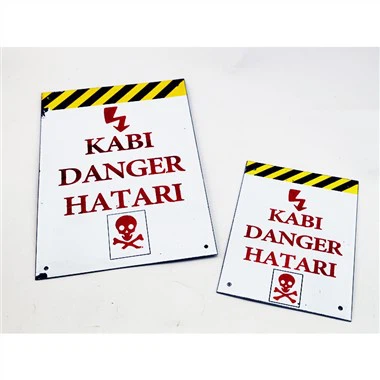
In Which Specific Locations Or On Which Equipment Is A High Voltage Hazard Warning Sign Required?
Mar 01, 2026
High voltage High Voltage Hazard Warning Signs shall be installed on all sites and equipment where high voltage electrical hazards may occur or where exposure to high voltage could cause personal injury. Here are specific scenario categories and explanations:
I. Power Production and Transmission Sites
Power plants and substations
High voltage generators and transformers: Voltage levels and hazard warnings shall be clearly marked on the housing or fence of the equipment.
Switching cabinets and distribution cabinets: cabinet doors or control panels must be marked ``high High Voltage Danger, do not touch ''.
High-voltage transmission lines: Warning signs must be placed near transmission towers, utility poles or cable terminals to prevent climbing or accidental contact.
GIS (Gas Insulated Switchgear) rooms: High-voltage equipment in enclosed spaces must be marked with a hazard warnings at the entrance.
Power Dispatch Centers
Warning signs must be placed in the control room or in front of the monitoring screens to alert the operator to the status of the high-voltage system.
ii. Industrial and manufacturing sites
Factory High-Voltage Equipment Areas
High-voltage motors and stoves: Voltage and hazard information shall be clearly indicated on the housing or guardrail of the equipment.
Welding machines and plasma cutters: High-voltage input equipment must have a clear warning.
High pressure test stand: High pressure test equipment in a laboratory or production line must be placed in an isolated area and clearly marked.
Chemical and metallurgical industries: Electrolytic cells, electric arc furnaces: hazardous areas must be delineated and marked around high-voltage power supply equipment.
Pipeline heating systems: If high voltage electric heating is used, the risk must be clearly identified on the piping or control boxes.
III. Buildings and infrastructure: construction site: temporary distribution boxes: high voltage input end must be marked ``high voltage hazard, prohibited for non-electrical operators' '.
Tower crane, construction elevators: if high voltage power supply is used, a warning sign must be placed on the control cabinet or operating panel.
Underground utility tunnels: High voltage cable laying areas must be marked at the entrance.
Urban infrastructure: Metro, tunnels: Warning signs must be placed around high-voltage power supplies,such as traction substations.
Streetlight control boxes: High voltage input must be labeled as a risk to prevent accidental contact.
Charging pile: If DC fast charging pile involves high voltage conversion, a warning must be displayed on the operating panel.
IV. INTRODUCTION Transport and logistics sector
Rail system
Overhead Contact Line, substation: warning signs must be posted on high voltage equipment along railway lines to prevent people from climbing or foreign objects from entering.
Roof of electric locomotive: during the maintenance process, the ``high voltage danger"sign must be placed on the high voltage equipment on the roof.
Aviation and shipping
Airfield light: Warning signs must be posted around control room or transformer of a high-voltage power supply device.
Ship power stations: Risk labels must be posted on the control panels of HGVs.
V. Special Environments and equipment
Medical Facilities
X-ray machines, CT Scanners: Risk labels must be posted on equipment room or control panels of the HV.
Operating room electrical room: If high-voltage electrocoagulation is used, a warning sign must be posted on the equipment for use by the operator.
Research and laboratories
Particle Accelerators, High-Voltage Power Supplies: warning signs must be posted at the entrance or operation area of experimental equipment.
Laser: Risk labels must be posted on high-pressure laser equipment to prevent accidental contact.
Agriculture and mining
Pumping Stations, Irrigation Pumping Stations: Warning signs must be set up around the HV motor.
Mine hoist: High pressure power winch must have a risk warnings on the control cabinet.
VI. INTRODUCTION Public Facilities and Maintenance Scenarios
Public facilities
High-voltage cable wells, underground substations: "High Voltage Danger, no entry" signs must be posted at the wellhead or entrance.
Billboard lighting: If high-voltage sodium lamps or LED drives are used, a risk warnings must be displayed on the distribution box.
Maintenance and Repair Scenarios
Power outage repair area: disconnect switches or circuit breakers must be displayed on the "High Voltage Danger, do not close" sign.
Site: Warning bars and signs must be placed around the work area.
VII. Other High-Risk Scenarios
Electric car repair shop
High-voltage battery packs or charging equipment must have warning signs on maintenance workstations.
Data centers
Danger warnings risk warnings displayed at the entrance to theUninterruptible Power Supply high voltage battery chamber.
Amusement parks
If a roller coasters, drop towers or other power system involves high pressure, signs must be posted around the control room or equipment.
Design Principles
Visibility: Signs must be installed in a prominent ergonomic position (generally 1.5 -2 m).
Durability: Outdoor signs must be made of corrosion and UV resistant materials (e.g. aluminum or reflective film).
Multilingualism: In international settings, additional language versions (e.g. Chinese and Spanish) should be included to reach different audiences.
Compliance: Signs must comply with local regulations (e.g. OSHA, ANSI, ISO 7010) and industry standards.
By installing high-voltage hazard warning signs on the above-mentioned locations and equipment, it can effectively alert personnel to the risks, prevent electrocution accidents and ensure the safety of life.