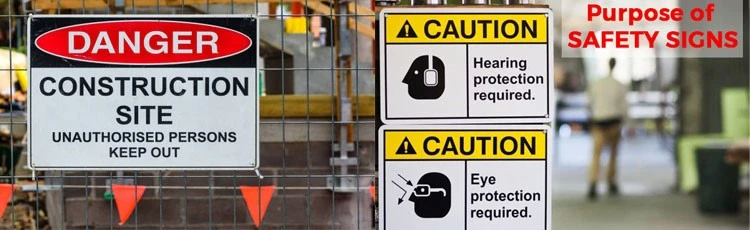
Applicable Places For Safety Signs
Aug 16, 2023
Safety signs are signs set up for safety reasons to reduce safety hazards and can be seen outside the factory entrance, inside the factory, and on roads. The safety signs required by the transportation department are divided into prohibited signs and attention to obstacles signs. Safety signage is a symbol composed of red, yellow, blue, and green as the main colors, supplemented by borders, graphic symbols, or text, used to express safety related information.
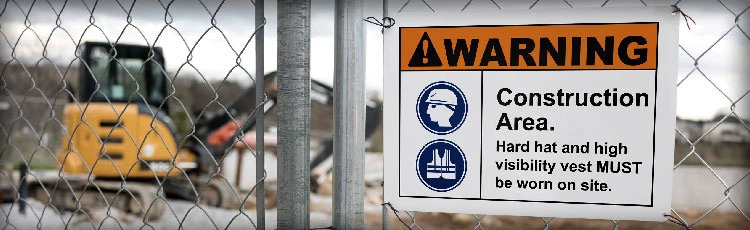
* Places where enterprises should set up safety warning signs
Production and business units shall set up obvious safety warning signs on production and business premises and related facilities and equipment with significant risk factors. Enterprise safety warning signs should be set up at the entrances of construction sites and factories, as well as at prominent positions at the entrances of workplaces and workplaces. The specific requirements for different types of industries are as follows:
1. Hazardous chemical enterprises. The workplace, safety facilities, and equipment of units producing and storing hazardous chemicals, specialized warehouses for hazardous chemicals, and hazardous chemical pipelines laid; Dangerous chemical transportation vehicles; Ships carrying hazardous chemicals navigate, load, unload or berth in inland rivers; Shipment of hazardous chemical outer packaging.
Production areas, general warehouse areas, warehouses, and other production and business premises and related facilities and equipment of fireworks and firecrackers production enterprises and wholesale enterprises with significant risk factors; Retail premises (flammable and explosive).
2. Metallurgical enterprises and non-ferrous metal enterprises. Places, facilities, and equipment with significant risk factors, as well as places where enterprises producing, storing, and using gas may experience gas leakage or gathering.
3. Industrial and trade enterprises. Limited space workplace.
4. Food production enterprises. Places with hazardous factors and related facilities and equipment.
5. Small open-air quarries. Entrance roads and related hazard sources.
6. Coal bed methane enterprises. Key monitoring areas for hydrogen sulfide, areas where hydrogen sulfide and sulfur dioxide may accumulate, and compressor rooms; At the entrances of the well pad, drill floor, and derrick ladder, on the drill floor, in the high-altitude operation area, and in mechanical equipment such as winches, diesel engines, generators, oil tank areas, fire equipment rooms, fire equipment boxes, and other places and equipment facilities; Protective containers for transporting radioactive sources, and warning areas for outdoor and outdoor work on radioactive sources; Along the pipeline; The entrance, enclosure (fence), coalbed methane storage tank area, machine room, and distribution area of the station.
* Principles for setting up safety warning signs
1. Standards: The graphics, dimensions, colors, and materials should comply with the standards.
2. Safety: After setting, there should be no potential danger in itself, ensuring safety.
3. Eye-catching: The location should be eye-catching.
4. Convenience: The position and angle set should be convenient for people to observe and capture information.
5. Coordination: The height, size, and surrounding environment of each sign board set up in the same place should be coordinated and unified as much as possible.
6. Reasonable: Try to use an appropriate amount of safety signs to reflect necessary safety information, and avoid omissions and overuse.
* Basic requirements for using safety warning signs
1. Important parts and key positions with safety risks on site must be equipped with safety warning signs that can provide corresponding safety information. According to relevant regulations, important areas with safety risks such as on-site entrances and exits, construction lifting machinery, temporary electrical facilities, scaffolding, passageways, stairwells, elevator wellheads, holes, foundation pit edges, storage areas for explosives and toxic and harmful substances, etc., should be equipped with clear safety warning signs. For example, setting up prohibited signs such as no smoking or fireworks in the storage area of explosives and toxic and harmful substances; Set up warning signs next to the woodworking circular saw, such as "Danger of Hand Injury"; Set up safety channel and other warning signs at the channel entrance.
2. Safety warning signs should be set up at the corresponding hazardous locations involved or at the most easily observable locations attached to the equipment.
3. Safety warning signs should be set up in a bright and well lit environment. For example, if the position where the sign should be set up and the additional light is dim, additional auxiliary light sources should be considered.
4. The safety warning sign should be firmly fixed on the support object, without tilting, curling, swinging, and other phenomena. The height should be consistent with the height of the human eye as much as possible.
5. Safety warning signs shall not be placed on movable objects such as doors, windows, and frames. The front of the warning signs or their vicinity shall not have fixed obstacles that hinder people from trying to read, and they shall be avoided from being frequently obstructed by other temporary objects as much as possible.
6. When multiple safety warning signs are arranged together, they should be arranged in the order of warning, prohibition, instruction, and prompt types, from left to right, and from top to bottom. The distance between each sign should be at least 0 or 2 times the size of the sign.
7. Places with electric shock hazards should use safety warning signs made of insulating materials.
8. The fire safety signs set up in outdoor outdoor places should use warning signs made of reflective or self luminescent materials.
9. For places with fire protection requirements, safety warning signs made of non combustible materials should be selected.
10. The safety warning signs arranged on site should be registered and recorded, and a general plan of safety warning layout should be drawn. They should be arranged according to the plan. If there are changes in the layout points, they should be kept updated in a timely manner.
11. The safety warning signs arranged on site shall not be moved, displaced, dismantled or replaced by anyone without permission.